Steinway Hall New York: A Tour Through History

Steinway Hall New York: A Tour Through History

Estimated reading time: 5 minutes

In the heart of Manhattan’s Midtown lies Steinway Hall, home to the world’s most coveted pianos. For over a century, Steinway has symbolized both musical excellence and New York’s cultural elite. Once a Rococo-style salon near Carnegie Hall, Steinway Hall has transformed into a modern architectural gem. Let’s take a look at the old Steinway Hall and its present-day piano salon in New York.

Where Is Steinway Hall Today?

The current Steinway Hall is located at:
1133 Avenue of the Americas, New York, NY 10036

Interestingly, this building once housed the International Center of Photography (ICP Museum). When I first moved to New York, I remember seeing photo books by the Japanese photographer Nobuyoshi Araki displayed in the windows. Today, those same windows reveal gleaming black Steinway grand pianos under bright lights.

In 2016, Steinway Hall relocated here after its legendary 57th Street salon closed due to a lease expiration. That move was bittersweet, as generations of musicians had cherished the old space. The historic building has since been converted into condominiums.

Alt="A picture of the old Steinway hall"

The Old Steinway Hall (1925–2014, 57th Street)

The former Steinway Hall on West 57th Street was a stunning Rococo-inspired interior. Its chandeliers and ornate details reflected European luxury and the grandeur of the Romantic music era.

This was not just a showroom—it was a cultural salon where pianists like Arthur Rubinstein and Vladimir Horowitz frequently performed. Even my own piano professor held his doctoral recital there.

Alt="The old Steinway Hall with a beautiful white grand piano by the window"

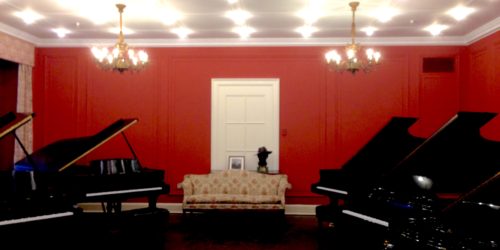
One highlight was the Rubinstein Room, with salmon-pink walls influenced by German design. Inside, visitors could play the pianos, admire Rubinstein’s portrait, and even see a bronze cast of his hands. The atmosphere evoked both pre-war Europe and post-war New York, a mix of glamour and history.

alt="A picture of Rubinstein room in salmon red"
alt="A panting of Arthur Rubinstein's portrait"

The Modern Steinway Hall (Since 2016, Midtown)

Step into today’s Steinway Hall, and you’ll find a completely different atmosphere. The chandeliers are gone, replaced by sleek minimalism.

  • Reflective black pianos line the glass walls.
  • The ceiling curves echo the shape of grand pianos.
  • The design reflects minimalist music, reminiscent of American composers like Steve Reich and Philip Glass.

Where Rubinstein and Horowitz once dominated, today you’ll find Steinway Artists such as Lang Lang and YuJa Wang featured in displays and promotional material.

A Hidden Lighting Masterpiece

One of the most breathtaking features of the new Steinway Hall is its lighting installation, inspired by Bach’s Goldberg Variations. Each hanging light represents one of the 30 variations, resembling a cascade of origami cranes.

alt="new Steinway Hall's lighting installation, inspired by Bach’s Goldberg Variations"

This design is only visible if you walk to the back of the showroom, making it a delightful surprise for visitors. Architecture lovers will find this as inspiring as the pianos themselves.

Why Steinway Remains a Symbol of New York

From its Rococo origins to its sleek modern incarnation, Steinway Hall has always been more than a piano showroom. It is a space where history, music, and architecture meet.

Whether you admire its past grandeur or today’s minimalist elegance, Steinway Hall continues to represent the pinnacle of piano craftsmanship and cultural prestige in New York City.

alt="the pianist Lang Lang's poster above a brown upright Steinway piano and American Flag on the side"

Conclusion

The history of Steinway Hall is deeply intertwined with Manhattan itself. From 14th Street in the 19th century, to 57th Street’s legendary salon, and now Midtown’s glass-walled modern hall, Steinway has reinvented itself while staying true to its legacy of excellence.

For musicians, music lovers, and architecture enthusiasts alike, Steinway Hall remains a must-visit destination in New York City.

Return to Home

Dental Care in New York: My Experience with Dentists and the High Costs

Dental Care in New York: My Experience with Dentists and the High Costs

Living in New York is expensive in every way, and dental care is no exception. Many people are shocked when they receive their dental bills—especially because dental insurance in the U.S. rarely covers cavities or implants. In fact, I’ve come to realize that teeth are an asset. Yes, “asset” (資産) in the financial sense. Once you experience dental care in New York, you’ll understand why.

Today, I’d like to share my own near “trap” experience at a dentist in Midtown Manhattan, along with my husband’s much more painful (and expensive) encounter with cavities in NYC.

What Do Teeth Mean to Americans?

In Japan, slightly crooked teeth are not a big deal. But in the U.S., it can impact your social life and even career success. Orthodontics came from the U.S. to Japan, and here it’s considered essential.

  • News anchors on CBS or NBC always have bright white, straight teeth.
  • Many apply dental veneers or “tooth manicure” to achieve that Hollywood smile.
  • Portrait ads and posters in New York almost always feature perfect, glowing teeth.

In short, in America, a beautiful smile = social credibility.

Dental Care Products in Stores

When you walk into any New York pharmacy (like CVS or Walgreens), the dental care aisle is massive. From electric toothbrushes to whitening kits, the options are endless.

Japan is catching up now, but 15 years ago the U.S. was far ahead.

My Experience: A Fake Cavity in Midtown Manhattan

Years ago, I went to a Japanese dentist in Midtown Manhattan for a simple cleaning. Afterward, the dentist told me I had a cavity “almost reaching the nerve” and urged me to treat it immediately—at a cost of $300 for one tooth.

I felt uneasy because I had zero pain, so I ignored it.

One year later, when I visited my hometown dentist in Japan: Result: No cavity.

This made me realize that some NYC dentists are quick to “find” cavities and recommend expensive treatments or even unnecessary extractions.

The Cost of Dental Cleaning in NYC: Then vs. Now

  • 10–15 years ago: about $100 for a cleaning.
  • Today (2025): average $200–$400 depending on the clinic.

My husband’s dentist charges $400 per cleaning, though he continues to go because of trust. Personally, I would not.

My Husband’s Horror Story: Columbia University Dental

My husband had multiple severe cavities due to bad habits in his youth (eating sweets and falling asleep without brushing).

At Columbia University’s dental clinic, he was told:

  • 4–5 teeth must be extracted.
  • Implants were necessary.
  • Estimated cost: $50,000 (over ¥6.5 million).

Even with insurance, not everything is covered. The system is designed so that implants are extremely profitable for dentists.

He ended up refusing Columbia’s treatment and went to a Chinatown dentist instead (not something I’d recommend).

Japanese Dentist’s Perspective: Teeth Can Heal

Later, his Japanese dentist explained something surprising:

“Teeth can sometimes regenerate. Extraction should be the very last option.”

This is a stark contrast to NYC, where dentists tend to remove and replace teeth more aggressively.

The “Luxury Dentist” Culture in NYC

This may sound like gossip, but at dental association events in New York, many dentists show up in luxury suits, designer watches, and perfect Hollywood smiles.

It’s no surprise when you realize how profitable implants are. There was even a Japanese dentist in NYC whose flashy lifestyle and scandals once made headlines in local Japanese media.

Why Teeth Are Truly an Asset

From my husband’s $50,000 bill, I realized: healthy teeth = financial savings.
The better you care for your teeth, the less you’ll spend later.

How I Keep My Teeth Cavity-Free

Here are my simple habits that have kept me cavity-free:

  • Rinse my mouth after sweets.
  • Drink milk (calcium helps).
  • Brush after eating rice or noodles.
  • Use a toothbrush that reaches behind molars.

Conclusion

Dental care in New York is high-quality but very expensive. Some dentists may even push unnecessary treatments. Personally, I trust Japanese dentists more—especially after seeing how aggressive the NYC dental industry can be.

Your teeth are your asset, so protect them wisely.

Return to Home

Health Insurance in the U.S.: What Artist Visa Holders Need to Know

Health Insurance in the U.S.: What Artist Visa Holders Need to Know

USA_insurance1

Estimated reading time: 4 minutes

If you’ve just received your O-1 Artist Visa in the United States, congratulations! But before you dive into your creative journey, there’s something essential you need to understand—health insurance in America. Medical costs in the U.S. are among the highest in the world, and having proper coverage isn’t just a recommendation, it’s a necessity.

In this article, I’ll explain why insurance is so important for artist visa holders, what options are available, and how you can protect yourself while living in the U.S.

What Is an Artist Visa (O-1 Visa)?

The O-1 visa, commonly called an artist visa, is granted to individuals with extraordinary ability in the arts, music, film, design, or other creative fields. Unlike H-1B workers, most O-1 visa holders do not automatically receive health insurance from an employer, which means you need to arrange coverage on your own.

Do Visa Sponsors or Employers Cover Health Insurance?

In short—rarely.
Unlike in some countries, U.S. employers are not always required to provide health insurance, especially for freelancers or artists on O-1 visas. Even middle-class Americans often don’t have employer-covered insurance, so it’s up to you to secure your own plan.

The Reality of U.S. Medical Costs

American healthcare is world-class in quality—but also world-class in cost. Here are some average expenses without insurance:

  • Ambulance ride: $1,000+ (over ¥100,000)
  • Surgery: $3,000+ (over ¥300,000)
  • Doctor’s visit: $200–$300 (¥20,000–¥30,000)

For an uninsured artist, one accident or emergency could lead to overwhelming debt.

My Personal Experience With U.S. Healthcare

When I was misdiagnosed with glaucoma by a doctor in Japan, it was only at Mount Sinai Hospital in New York that I received the correct diagnosis—retinal detachment. Thanks to skilled specialists and advanced technology, I received proper treatment and recovered.

This experience showed me that while costly, U.S. healthcare can be more accurate and reliable in certain situations.

Health Insurance Options for Artist Visa Holders

If you’re a student, or even a freelancer with an O-1 visa, you’ll likely need to explore private health insurance. One reliable option is ISO International Student Insurance, which also offers plans for non-students.

Example Coverage I’ve Used:

  • Retinal detachment surgery: $3,000+ covered
  • Women’s health exams
  • Emergency medical care: $1,000+ covered

ISO Monthly Premiums:

  • Ages 20–24: $79/month
  • Ages 25–29: $89/month
  • Ages 30+: $119/month

Plans can be paid quarterly or annually, and may even help with tax deductions.

Is Health Insurance Really Necessary in New York?

Absolutely.
Living in New York means unexpected things can happen—accidents, sudden illnesses, or even health risks from diet and lifestyle. Without insurance, the financial burden can be devastating. Think of health insurance as your safety net and peace of mind.

How to Enroll in ISO Insurance

  1. Visit the ISO website.
  2. Select “Non-student” if you hold an O-1 artist visa.
  3. Enter your age to see monthly rates.
  4. Choose and purchase your plan online.

Final Thoughts

For O-1 artist visa holders in the U.S., securing health insurance is not optional—it’s essential. While ISO is one recommended option, compare different plans to find what best suits your budget and needs.

Your health is the foundation of your artistic journey—don’t risk it by going uninsured.

Back to Home

Tartinery Cafe New York – A Cozy Cafe at Columbus Circle and Grand Central 

Tartinery Cafe New York – A Cozy Cafe at Columbus Circle and Grand Central

Tartinery cafe

If you’re looking for a stylish and comfortable cafe in Manhattan, Tartinery Cafe is a great choice. Located inside the Time Warner Center (now Deutsche Bank Center) at Columbus Circle, this cafe is also conveniently found at Grand Central Terminal, making it perfect whether you’re shopping, commuting, or just looking for a good coffee spot in New York City.

The Atmosphere at Columbus Circle

On rainy weekday mornings, Columbus Circle can feel surprisingly calm compared to its usual busy evenings when Whole Foods Market downstairs gets crowded. That’s when Tartinery Cafe becomes the ideal spot to relax with a coffee or get some work done.

The Wi-Fi is provided by services like Amazon and Jazz at Lincoln Center, and it’s reliable enough for working online.

A Cafe with a View

columbus_circle_inside

From the second floor of the Time Warner building, you get a nice view of Columbus Circle. Nearby, you’ll also find Amazon Books and plenty of shopping, making it a convenient location.

Tartinery itself is located on the third floor, where the cafe and restaurant share a cozy space. Previously, this spot used to be Magnolia Cafe, but it was transformed into Tartinery, bringing a new design, fresh menu, and better coffee.

What to Try at Tartinery Cafe

menu at the cafe

The menu is simple but delicious. When I asked the friendly staff which baguette they recommended, one of them suggested the ham and cheese baguette—and it did not disappoint!

I paired it with an iced latte that was creamy with plenty of milk, the perfect balance with the sandwich. Unlike some cafes in New York that serve very acidic coffee, Tartinery’s blend is smooth and well-balanced, making it great for those who prefer a mellow taste.

Multiple Locations in Manhattan

Ice latte at Tartinary

Besides Columbus Circle, you can also find Tartinery Cafe inside Grand Central Terminal, which is perfect for commuters or anyone passing through Midtown Manhattan.

Conclusion

If you’re searching for a comfortable cafe in New York City with good coffee, fast Wi-Fi, and a cozy atmosphere, Tartinery Cafe is worth visiting. Whether you’re near Columbus Circle or Grand Central, this cafe is ideal for both work and relaxation.

Back to Home

Kura Sushi Fort Lee: A New Sushi Adventure

Kura Sushi Fort Lee: A New Sushi Adventure


After much anticipation, Japan’s famous conveyor belt sushi chain, Kura Sushi, has made its way to New York! Located just outside Manhattan in Fort Lee, New Jersey, Kura Sushi offers a convenient and accessible dining experience for sushi lovers. Let’s dive into the charm of this unique sushi destination.

Estimated reading time: 5 minutes

くら寿司の緑茶の写真

How to Get There

Getting to Kura Sushi in Fort Lee is a breeze from New York City. You can take the A line subway to 175th Street Station, and from there, take a bus across the George Washington Bridge. After a short 1-minute walk, you’ll find Kura Sushi waiting for you! It’s a convenient and easy access point for those in Manhattan and surrounding areas.

The Atmosphere Inside

くら寿司の回転寿司の模様

Don’t worry if you’ve never visited a Kura Sushi in Japan. The Fort Lee location captures the same welcoming vibe. The aroma of vinegar rice greets you as you step inside, instantly evoking the feeling of dining in a traditional Japanese sushi restaurant. During the pandemic, many of us missed out on enjoying sushi in restaurants, but Kura Sushi provides a cozy, comfortable space where you can savor sushi at your own pace. With plenty of group and counter seating, it’s perfect for solo dining or enjoying a meal with friends and family. Don’t worry if you’re unsure how to grab sushi from the conveyor belt—the friendly staff will guide you through the process.

What Makes Kura Sushi So Special?

The standout feature of Kura Sushi is undoubtedly its conveyor belt sushi system. Plates of various sushi selections are placed on the conveyor, letting you grab whatever looks appetizing as it comes around. The quality is superb, especially considering the affordable prices. For just $3, you get a set that includes green tea, ginger, and wasabi—a fantastic value for the taste and experience. Sushi plates are priced at $3.15 for two pieces, making it a reasonable choice for a delicious meal in New Jersey.

  • Squid
  • Tai with Yuzu Garlic
  • Salmon Skin Roll
  • Spicy Popcorn Shrimp Roll
  • Tuna Yukke Roll
  • Shimaji
  • Conchi (Known for its chewy texture)
いかのお寿司の写真
Squid
red snapper kura sushi
Red snapper with Yuzu garlic
salmon skin roll kura sushi
Salmon Skin Roll
gari and wasabi kura sushi
Wasabi and Gari
Shrimp tempura roll at kura suhi
Spicy Popcorn Shrimp Roll

While the variety of fish may be more limited compared to Japan, the selections offered at Kura Sushi in Fort Lee still provide a satisfying experience for sushi enthusiasts.

A Special Experience: Gacha-Gacha Surprise

kura sushi gacha game
kura sushi gift for eye glasses cleaner

In addition to the conveyor belt sushi, Kura Sushi adds an element of fun to your dining experience. When you order sushi from the touch screen menu, you’ll encounter a Gacha-Gacha (Japanese capsule toy) surprise. From the hole next to the order screen, you might receive a fun trinket like a cleaning cloth or other small surprises. It’s a quirky touch that adds to the overall enjoyment of your meal.

Summary: A Must-Visit Sushi Spot in New Jersey

Kura Sushi in Fort Lee is the perfect place for anyone craving authentic conveyor belt sushi while in the New York area. While the fish selection might not be as extensive as in Japan, the sushi’s quality, the unique experience, and the atmosphere make it a must-try for anyone looking to indulge in Japanese sushi culture.

Whether you’re a sushi connoisseur or just looking for a fun dining experience, Kura Sushi delivers it all. Be sure to check it out on your next trip to New Jersey!

Back to Home